

What are Clusters
TOTAL clusters Personas with a modified DBSCAN approach. Grouping emphasizes accuracy and ease of risk assessment, with highest weight on risk-sorted attributes so cohorts align with how security teams think about exposure and behavior similarity—not merely org chart proximity. Cluster membership enables drift from cluster (see Drift Insights) and metrics such as cluster switching volatility when identities move between behavioral cohorts over time.Cluster View
From the Persona Directory, open the cluster grid to see all clusters as cards with counts, or open a specific cluster’s detail page for cohort-level attributes and members.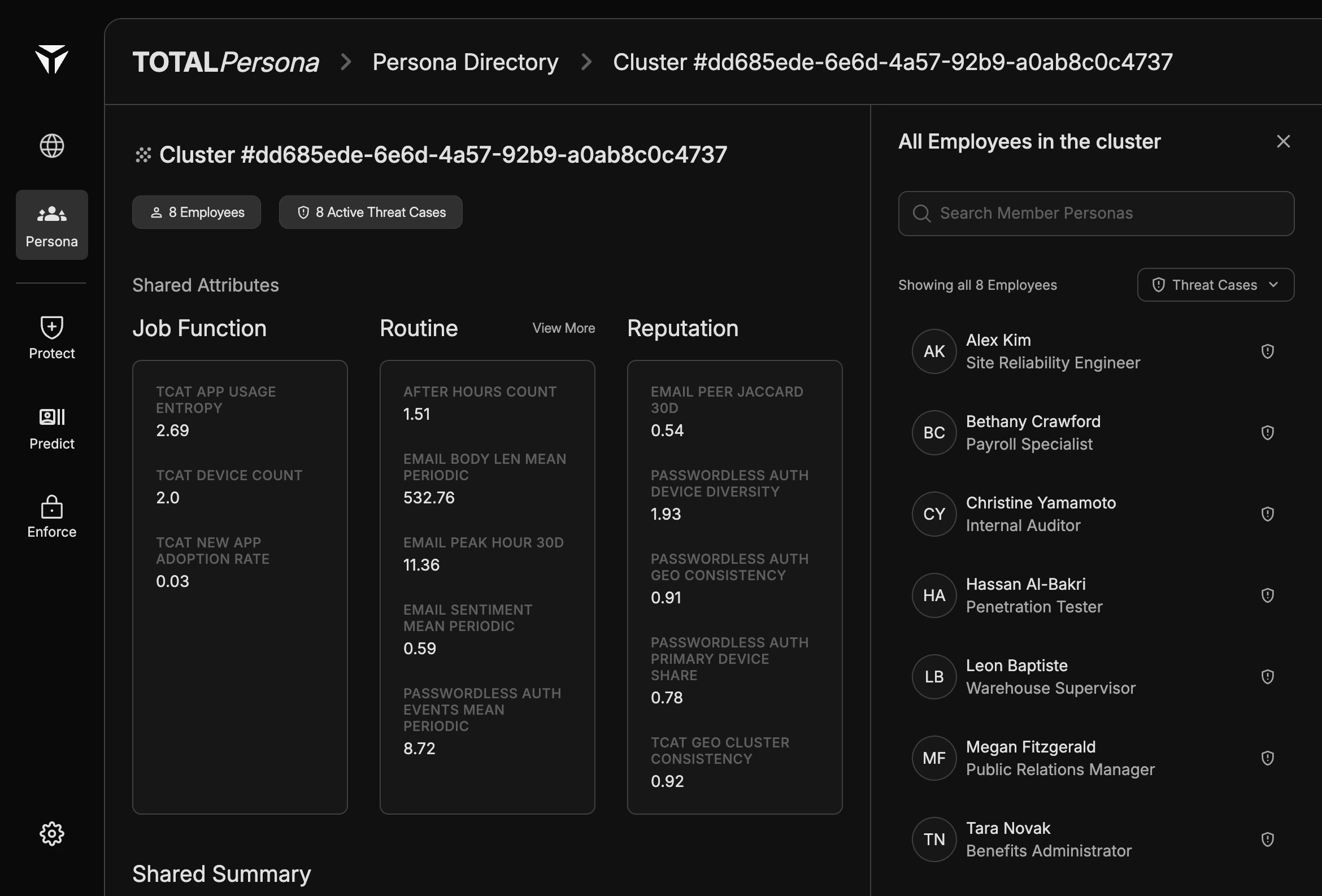
Shared Attributes
Cluster pages summarize Shared Attributes across members—typically organized into areas such as:- Job Function: role-aligned behavior and access congruence signals.
- Routine: work rhythm, geo-temporal, and stability-related dimensions.
- Reputation: continuity, enrollment trust, and peer-relative standing where modeled.