

- GET User: API to get TruU user by UPN, Email, GUID or TUID
- DELETE User: API to delete TruU user by GUID
- GET Device: API to get TruU user by UPN, Email, GUID or TUID and device by device ID
- DELETE Device: API to delete device by TruU user GUID and device ID
- Users: The Users API will return the users and their enrolled devices
- Assets: The Assets API will return the workstations and the enrolled accounts on those workstations (including user information)
- Create and OAuth Client through the Admin Console
- Obtain a Bearer token using the OAuth credentials
- Use the Bearer token in the authentication header when calling TruU APIs
Step 1: Creating OAuth Clients
We will start by adding a “User Operations” OAuth Client in the Admin Console. This will create a new OAuth credential pair (a client ID and secret) that will be needed to access the API- Navigate to the “Integrations/OAuth Clients” tab on the TruU Admin Console
- Click the (+) button
-
Select “User Operations”
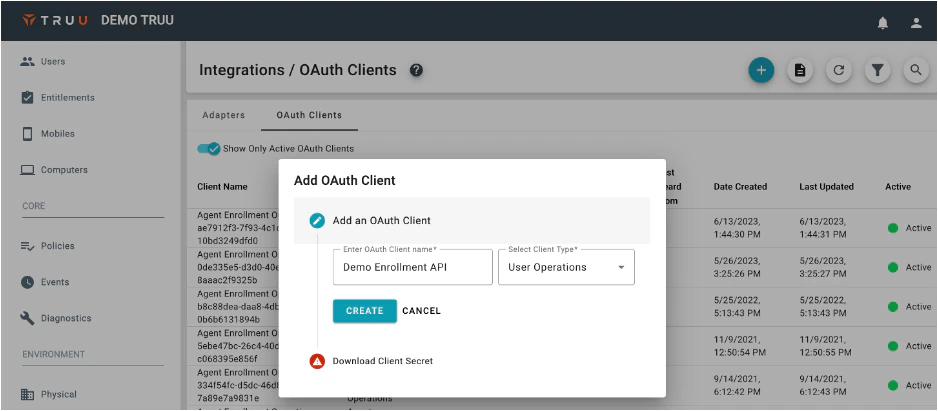
- Name the OAuth Client (e.g., Enrollment API)
- Click Create
- Click Download And Finish
Step 2: Use the OAuth Client to Call the API
As mentioned above, the User Operations API can be used to GET and DELETE Users and Devices. The example below explains how to use the Enrolled Users API Retrieving an OAuth Token Use the details from the configuration file downloaded when you provisioned a “User Operations” OAuth Client from your TruU admin console in order to retrieve a bearer token- GET
-
upn
- User Principal NameFull matching only
- Case insensitive
-
email
- Email addressFull matching only
- Case insensitive
-
guid
-
User identifier from directory
- Active directory: objectGUID
- Entra ID: id
- Okta: id
- Full matching only
- Case insensitive
-
User identifier from directory
-
tuid
- TruU user ID
- Full matching only
- Case insensitive
-
page
- Include this query parameter to fetch a specific page of results
- Page 1 will be returned by default if omitted
- Authorization: Bearer <token>
- application/json
- 200
Device Management API
API Endpoint = https://global.platform.truu.ai/api/v1/system/devices/ The TruU Device Management API retrieves information about enrolled devices and associated users. Supported HTTP Methods- GET
- Authorization: Bearer <token>
- application/json
- 200
User Management API
API Endpoint = https://global.platform.truu.ai/api/v1/system/domainusers/<guid>/ The TruU User Management API supports user and device deletion. Supported HTTP Methods- GET / DELETE
-
guid
- User identifier from directory
- Active Directory: objectGUIDEntra ID: idOkta: id Full matching only
- Case sensitive
- User identifier from directory
- Authorization: Bearer <token>
- application/json
- 200 / 204
-
When using this API with no query parameters, all users will be returned and paginated at 25 users per page. The supported parameters for Users are:
- page: this is an integer which can be used to select which page you want to receive. (Note: if you enter a page that does not exist, the query will return an error.)
- userPrincipals: we support any number of UPNs (and are case insensitive in our search)
- emails: we support any number of email (and are case insensitive in our search)
- guids: we support any number of guids (and are case insensitive in our search)
- NOTE: when using a single parameter (e.g., emails, you can include many emails) the query will be run as an OR. If you mix parameters, (e.g. emails and guids) the query will be run as an AND.
- GET
- Authorization: Bearer <token>
- application/json
- 200
- 100 = Basic
- 300 = Trusted
- 500 = Certified
Assets Data API
API Endpoint = https://global.platform.truu.ai/data/api/v1/assets/ The Assets API will return the workstation and the enrolled accounts on that workstation (including user information) NOTE: the trailing slash must be included in the URL when querying this endpoint. Failing to do so will result in a 301 redirect HTTP response code with no results-
When using this API with no query parameters, all assets will be returned and paginated at 25 assets per page. The supported parameters for Assets are:
- page: this is an integer which can be used to select which page you want to receive. (Note: if you enter a page that does not exist, the query will return an error.)
- ipAddresses: we support any number of IP addresses
- macAddresses: we support any number of MAC addresses
- GET
- Authorization: Bearer <token>
- application/json
- 200
- 100 = Basic
- 300 = Trusted
- 500 = Certified.
How to Determine Whether Agent is using FIDO2 or Cert based login MacOS Local Account Creation Control for ADE